
By Kulmeet Kundlas MD, Board-Certified Internal Medicine — Shield Medical Group, Sebring and Lake Wales, Florida
The house is quiet, the lights are off, and you are wide awake rubbing your hands and the bottoms of your feet. Lotion did nothing. The allergy pill did nothing. Your doctor looked at your skin and said it looks fine. I hear this story in my clinic two or three times a week. Very often, the real problem is not the skin. It can be the liver. In this guide, I will walk you through fatty liver itching: why it happens, the warning signs, the tests that find it, and what actually helps.
Watch Dr. Kundlas explain the link between fatty liver and itchy palms and soles in this video guide.
Disclaimer: This content is for educational purposes only and is not a substitute for personalized medical advice. Always consult your own healthcare provider for diagnosis and treatment.
What Counts as Chronic Itching?
An itch that hangs around for more than six weeks is called chronic. I pay closer attention when a patient has already done the simple things, such as drinking enough fluids and moisturizing every day, and the itch still keeps them up at night.
Most itching turns out to be harmless. Still, an itch that will not quit is your body asking for a second look.
Rule These Out First: Everyday Causes of Itching
Before I order liver tests, I check the common causes. In older adults, these top the list:
- Dry skin (xerosis): By far the most common cause after age 60. Skin loses oil and water with age. A thick, fragrance-free cream after bathing fixes most cases.
- Medicines and supplements: Many pills, vitamins, and herbal products can trigger itching. Put every bottle in a bag and bring it to your visit.
- Stress: Anxiety can turn a small itch into a big one.
- Kidney disease: Waste that the kidneys should remove can build up and make the skin itch.
Once these are handled and the itch is still there, the liver moves up my list.
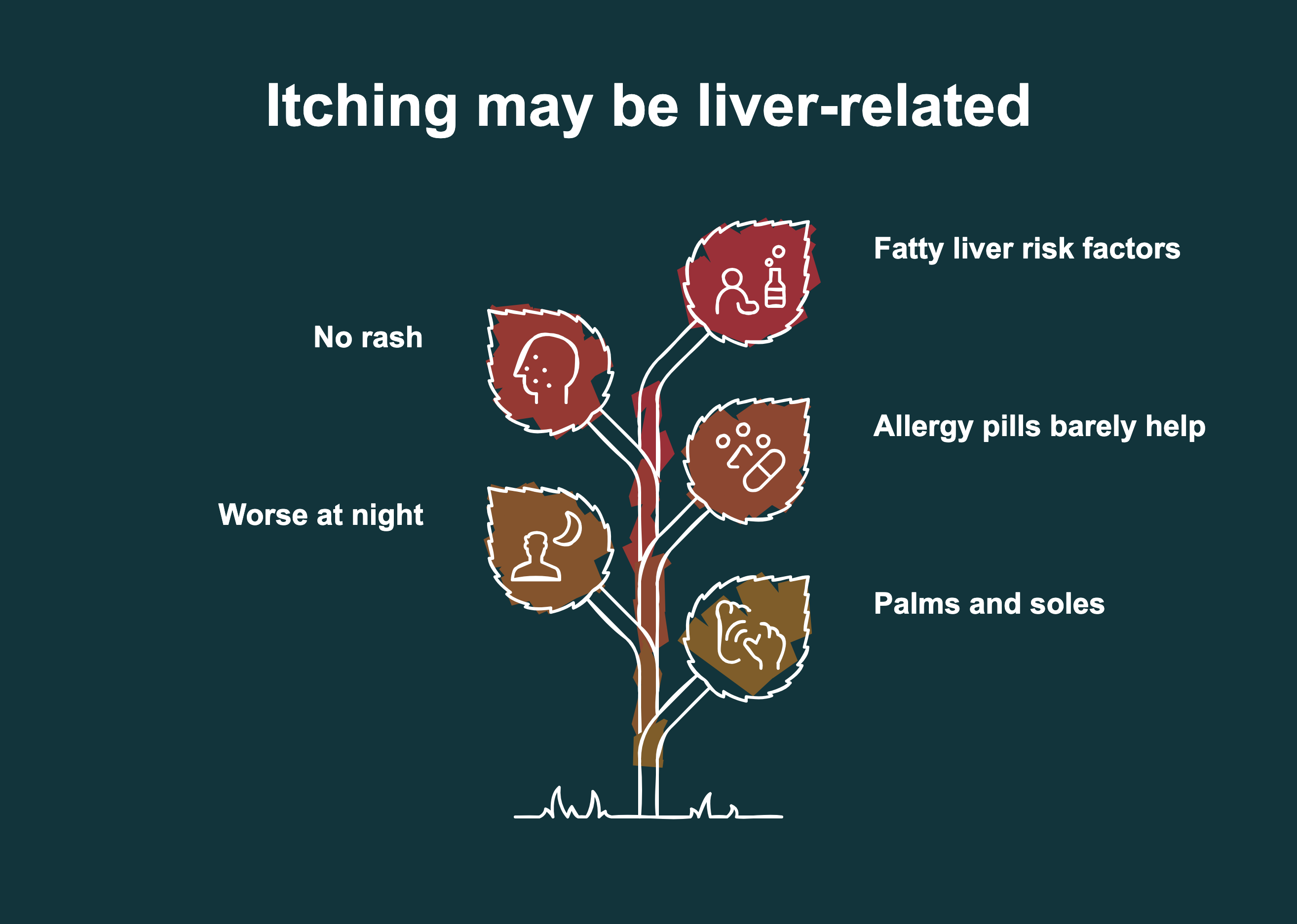
5 Warning Signs Your Itch May Be Liver-Related
Itching from the liver tends to follow a pattern. Watch for these clues:
- It targets the palms and soles. Liver-related itch often starts on the hands and feet rather than all over (DermNet).
- Nights are the worst. Many patients feel fine during the day and miserable after dark.
- Allergy pills barely help. Benadryl, Zyrtec, and Claritin block histamine. Liver itch runs on different chemicals, so these pills mostly just make you drowsy.
- There is no rash. The skin looks normal, apart from scratch marks.
- You have risk factors for fatty liver. Extra weight around the belly, type 2 diabetes, high triglycerides, or high blood pressure all raise the odds.
I want to be honest with you here. In early, mild fatty liver, itching is uncommon. Fatty liver itching shows up more often once the liver has started to scar or when bile does not drain well. That is exactly why an itch with these signs deserves testing, not just another bottle of lotion.
Fatty Liver Itching: Why It Happens
Doctors are still working out the full picture, but two explanations lead the way.
1. Bile salts spill into the bloodstream.
Your liver makes bile salts to break down the fat you eat, then sends them into the gut. Here is a key fact: blood from your stomach and intestines travels to the liver first, where it gets filtered before reaching the rest of your body. A damaged liver cannot keep up. Bile salts slip past it into general circulation and irritate the nerve endings in the skin, especially in the hands and feet.
2. Your body’s own “pain relievers” pile up.
Your body makes natural opioid-like chemicals called endorphins. A healthy liver clears them. A struggling one does not. If you have ever felt itchy after a strong pain pill, that is the same sensation.
Other itch-causing substances made by the liver likely play a part too (DermNet).
In plain English: when the liver falls behind on cleaning your blood, the leftovers make your skin itch.
Tests for Fatty Liver Itching
If your itch fits the pattern above, ask your doctor about these blood tests:
- CBC (complete blood count): Looks at your red cells, white cells, and platelets.
- Kidney panel: Makes sure your kidneys are not the cause.
- Liver panel: Includes ALP, an enzyme that rises when bile is not draining out of the liver well.
- Hemoglobin A1C: Screens for diabetes, which can cause its own burning and tingling in the feet.
To see how blood sugar affects more than just your glucose reading, read our guide on how diabetes affects your organs.
The FIB-4 Score: Your Liver’s Early Warning Number
FIB-4 has become one of my favorite tools. You do not need an extra needle stick. The lab calculates it from your age and a few results already on your blood work. It estimates how much scar tissue your liver may have.
How to read your FIB-4 score (Cleveland Clinic Journal of Medicine):
- Under 1.3: Low risk. Significant scarring is unlikely. Your doctor will usually recheck in 1 to 3 years.
- 1.3 to 2.67: In-between. The next step is usually a liver stiffness scan.
- Over 2.67: Higher risk. Ask for a referral to a liver specialist.
Age pushes the score up on its own, so for patients over 65, many doctors use 2.0 as the low-risk line instead of 1.3.
What is a liver stiffness scan?
When FIB-4 lands in the middle, I usually order a special ultrasound called elastography, which many people know as FibroScan. It sends soft pulses through the liver and measures how firm it is. A firmer liver means more scarring. There are no needles and it takes just a few minutes. A normal result means we can keep watching you in primary care. An abnormal one means it is time for a specialist.
MASLD and MASH: The New Names for Fatty Liver
Fatty liver disease has become one of the most common liver problems in the United States, largely because so many adults carry extra weight. It usually moves through three stages:
- Fat: Fat collects inside the liver cells.
- Inflammation: The fat irritates and inflames the liver.
- Scarring: Years of inflammation leave scar tissue. Heavy scarring is called cirrhosis.
If the names confuse you, you are not alone. NAFLD has been renamed MASLD (metabolic dysfunction-associated steatotic liver disease). The inflamed stage, once called NASH, is now MASH. Do not worry too much about the labels. Focus on the process: fat, then inflammation, then scarring.
Simple Ways to Ease the Itch at Home
While you work with your doctor on the cause, these steps can make nights more bearable:
- Take short, lukewarm showers instead of hot ones.
- Pat your skin dry and apply a thick, unscented moisturizer right away.
- Keep your bedroom cool. Heat makes most itching worse.
- Wear soft cotton socks and gloves to bed to protect your skin from scratching.
- Keep your fingernails short.
These tips soothe the skin, but they do not fix the liver. For that, keep reading.
How to Treat Fatty Liver Itching and Protect Your Liver
1. Lose weight if you need to.
Nothing works better. In a landmark study, people who lost at least 10 percent of their body weight cleared liver inflammation in 90 percent of cases, and close to half saw their scarring improve (Gastroenterology, 2015). Smaller losses still help. If you are on a GLP-1 medicine to lose weight, our post on GLP-1 side effects covers what to expect.
2. Do not waste money on “liver detox” supplements.
Milk thistle and liver cleanse products fill store shelves. Not one has been shown to reverse fatty liver.
3. Make your coffee black.
Patients are always surprised by this one. Research ties coffee to less liver scarring. In a long-term study of adults with fatty liver, those drinking 2 or more cups a day had a lower chance of developing advanced scarring (Nutrients, 2023). Skip the sugar and creamer. If coffee gives you palpitations or keeps you awake, talk to your doctor first.
4. Ask about prescription itch relief.
If the itch does not settle, several prescription options target liver-related itching specifically. Your doctor or a liver specialist can decide which one fits you.
When to See a Doctor Right Away
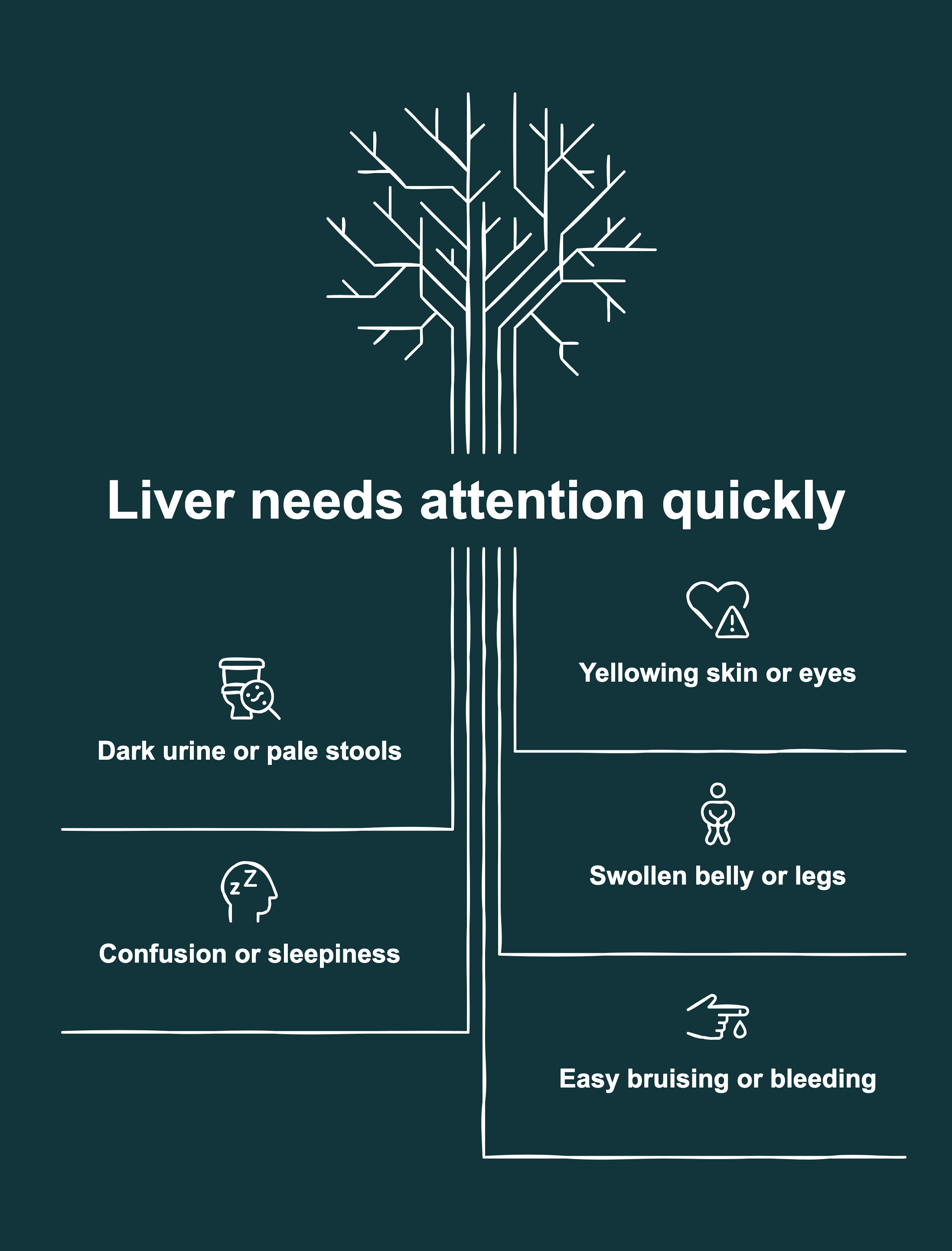
Call your doctor promptly if itching comes with any of these:
- Yellowing of the skin or the whites of the eyes
- Dark, tea-colored urine or pale stools
- A swollen belly or swollen legs
- Confusion or unusual sleepiness
- Easy bruising or bleeding
These can be signs that the liver needs attention quickly.
Frequently Asked Questions
Is fatty liver itching common?
Not in the early stage. Itching becomes more likely when the liver is scarred or bile is not draining properly.
Why do my palms and soles itch at night?
Dry skin is the usual reason. But itching of the hands and feet that worsens at night and ignores lotion can point to the liver. Ask your doctor for liver tests and a FIB-4 score.
What is a normal FIB-4 score?
Under 1.3 suggests low risk of liver scarring. Over 2.67 means you should see a liver specialist.
Does black coffee help with fatty liver?
Studies link 2 to 3 cups of black coffee a day with less liver scarring. It is not a cure, but it pairs well with weight loss.
How do you stop fatty liver itching?
Treat the liver first, mainly through weight loss. Gentle skin care helps at night, and your doctor can prescribe medicine if the itch persists.

