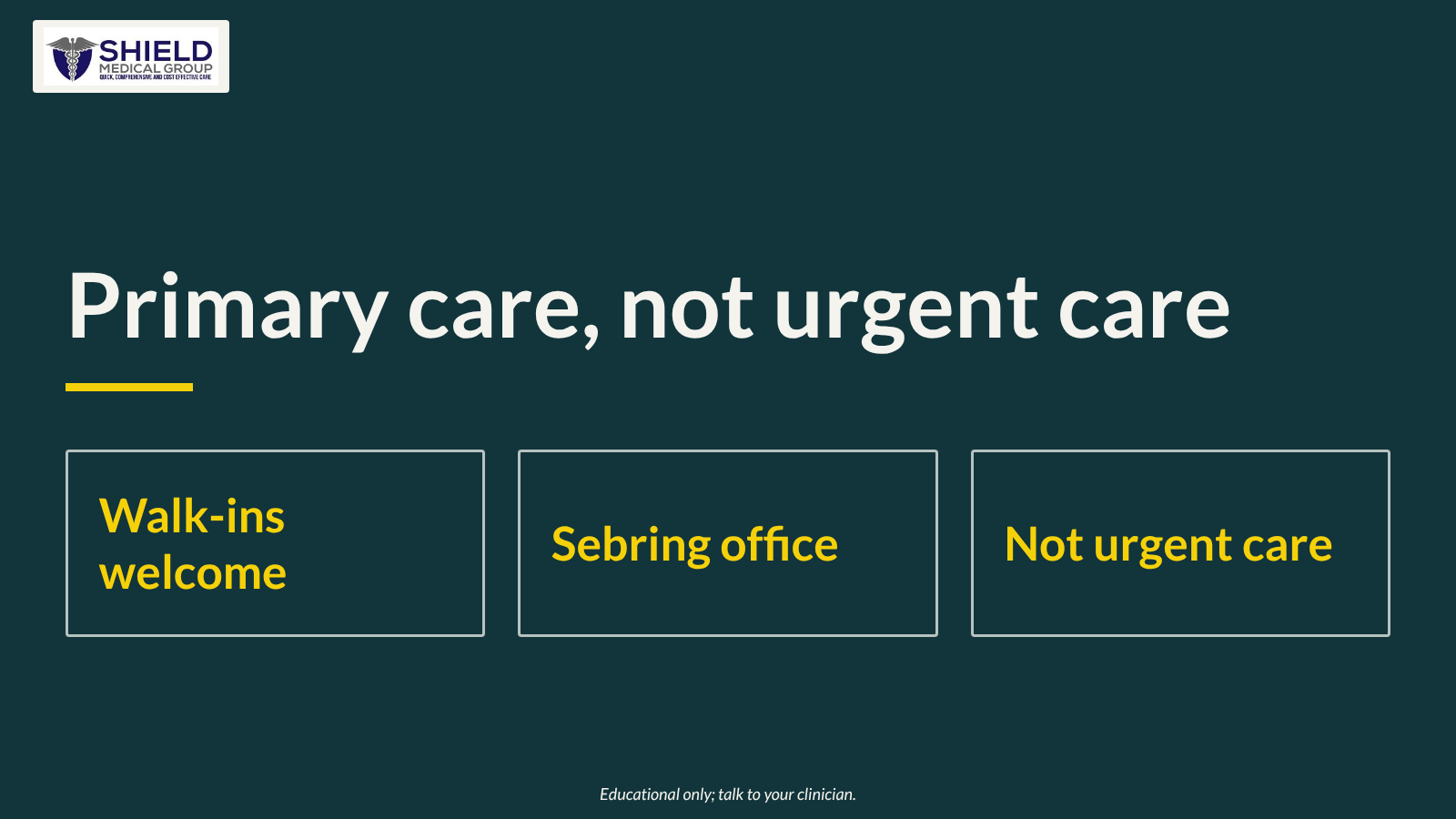
The honest starting point for primary care vs urgent care in Sebring is this: Shield Medical Group is a primary care practice, not an urgent care center, and it accepts walk-ins during office hours. You don't have to go to a standalone urgent care for every same-day problem. New and established patients are welcome at the Sebring office, 4597 Casablanca Cir, Sebring, FL 33870. Call (863) 236-9550. If you have warning signs of a heart attack or a stroke, call 9-1-1 immediately.
Primary care vs urgent care: what this practice is
Shield Medical Group is your primary care medical home. It accepts walk-ins during office hours. It's not an urgent care center and this article doesn't describe it as one.
It matters because many people search “urgent care Sebring” when they need to be seen today. The practice already explains the difference on its walk-ins welcome page: Shield Medical Group is a primary care practice, not an urgent care center, and it accepts walk-ins during office hours. Same-day sick visits and walk-ins are welcome for new and established patients during office hours.
This post is a comparison guide. For the step-by-step walk-in process, use the walk-ins welcome page. For a longer essay on independent primary care, see Independent Primary Care vs. Urgent Care. The Sebring office details remain on the Sebring primary care page.
Put simply, primary care vs urgent care is a choice between your medical home and a different kind of facility. In a primary care vs urgent care decision in Sebring, start with Shield Medical Group when the office is open. This primary care vs urgent care guide also explains when to skip both and call 9-1-1. People who search urgent care Sebring FL or what's urgent care vs ER still need that emergency advice first.
Sources: Walk-Ins Accepted in Sebring, FL (Shield Medical Group); Primary Care Doctor in Sebring, FL (Shield Medical Group); Independent Primary Care vs. Urgent Care: 5 Key Differences (Shield Medical Group)
What your primary care doctor can do when you walk in
A primary care visit, including a walk-in during office hours, happens in a practice that already knows, or can begin, your ongoing care, your medicines, and your chronic conditions.
The walk-ins page lists common walk-in reasons: a cold, flu and cough, sore throat or ear pain, sinus symptoms, urinary symptoms, minor rashes, blood pressure or blood sugar concerns, and questions about medicines.
Walk-ins are seen along with scheduled patients, so wait times vary. Calling ahead or booking online may shorten your wait. The Sebring page says you may call in the morning or walk in during office hours, and the practice will work to see you that day.
Sebring hours are Monday through Friday 8:00 AM to 5:00 PM, Saturday 10:00 AM to 1:00 PM, and Sunday closed. The Lake Wales office, at 23607 US Highway 27 N, Lake Wales, FL 33859, is open Monday through Friday 8:00 AM to 5:00 PM and is closed Saturday and Sunday. There's a free parking lot at the Sebring office, and the entrance is wheelchair accessible.
The physicians currently listed on the physicians page are Kulmeet Kundlas, MD, and Carlos M. Baez Cubille, MD. The practice cares for adults. Please bring a photo ID, your insurance card, a list of your medicines, and your questions.
That's the practical side of primary care vs urgent care when the Sebring office is open: walk in, or call, and the practice will work to see you that day.
Sources: Walk-Ins Accepted in Sebring, FL (Shield Medical Group); Primary Care Doctor in Sebring, FL (Shield Medical Group); Primary Care Doctor in Lake Wales, FL (Shield Medical Group); Meet Our Physicians (Shield Medical Group)

When people use an urgent care center
Urgent care is a different type of facility from a primary care office. This article doesn't describe Shield Medical Group as urgent care and doesn't invent a national list of what every urgent care can treat.
People often use an urgent care center when they want unscheduled care and their regular doctor's office is closed or can't see them soon. That's a real gap in some communities. In Sebring, Shield Medical Group already accepts walk-ins during office hours, including Saturday mornings at the Sebring office, which is why a same-day need doesn't automatically mean you must go to urgent care.
If the offices are closed, telehealth visits are available after hours, on weekends, and on holidays. This article doesn't quote a cash telehealth price from that page. If symptoms are life-threatening, call 9-1-1 rather than choosing urgent care, telehealth, or a walk-in.
A primary care vs urgent care comparison should stay honest: this article doesn't invent a list of what every urgent care can treat, and it doesn't call Shield an urgent care.
Sources: Walk-Ins Accepted in Sebring, FL (Shield Medical Group); Primary Care Doctor in Sebring, FL (Shield Medical Group); Telehealth in Florida (Shield Medical Group)
When to call 9-1-1 or go to the emergency room
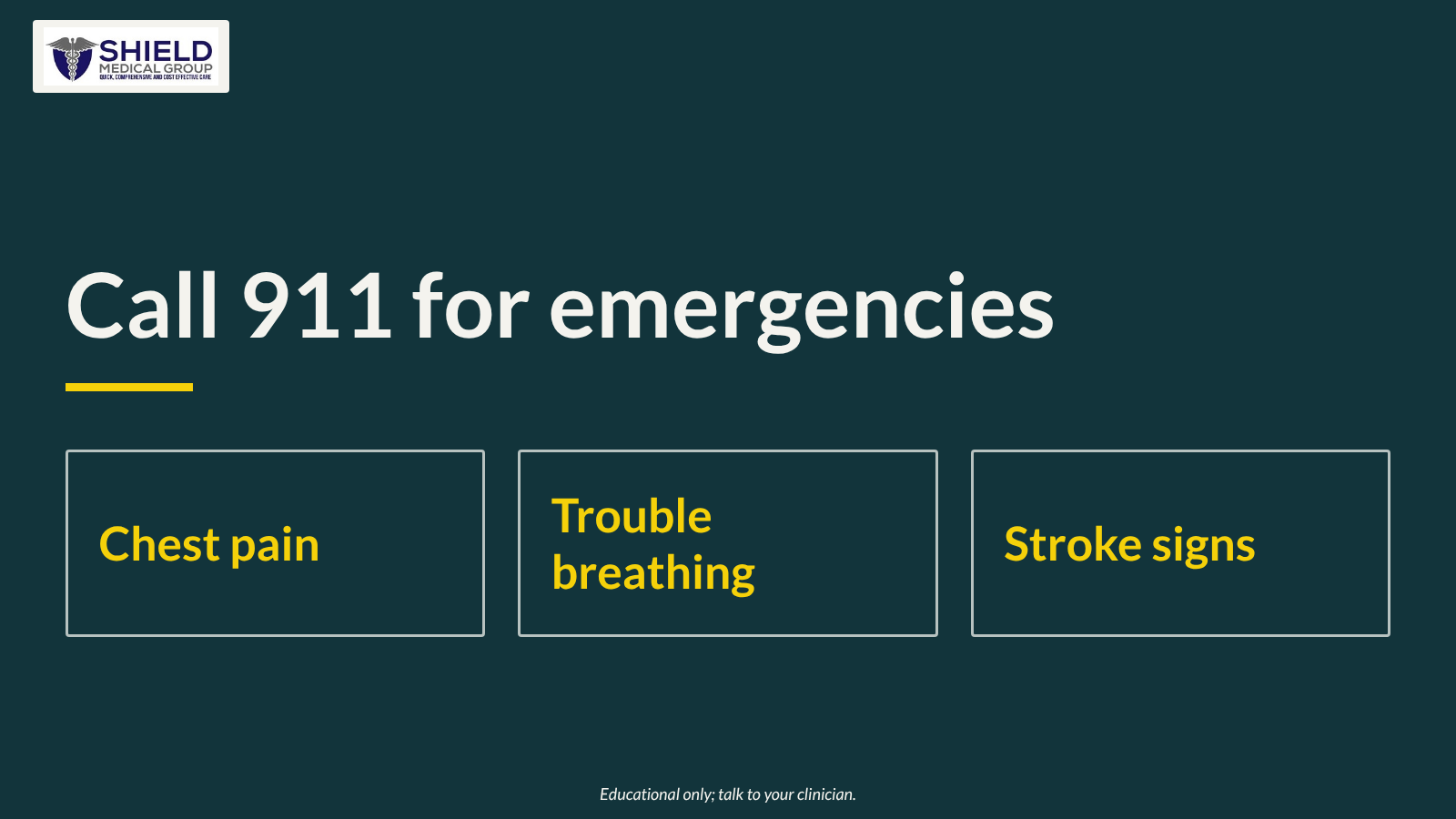
The emergency room is for life-threatening problems. Call 9-1-1 immediately if you notice symptoms of a heart attack or a stroke. That part of primary care vs urgent care isn't a close call.
The NHLBI heart attack symptoms page says heart attack symptoms can start slowly and can be mild or more serious and sudden, and they can differ from person to person and between men and women. Symptoms can include chest pain, heaviness, or discomfort in the center or left side of the chest (the most common symptom); pain or discomfort in one or both arms, the back, shoulders, neck, jaw, or above the belly button; shortness of breath; sweating a lot for no reason; unusual tiredness; nausea and vomiting; light-headedness or sudden dizziness; and a rapid or irregular heartbeat.
NHLBI says any time you think you might be having a heart attack, call 9-1-1 for emergency medical care, even if you are not sure. An ambulance is the safest way to get to the hospital; do not drive or let someone else drive you.
The NINDS stroke page says to act F.A.S.T.: Face drooping (does one side of the face droop when smiling?), Arm weakness (when arms are raised, does one drift down?), Speech difficulty (is speech slurred or strange?), and Time to call 911. NINDS says not to drive. Call an ambulance immediately, because every second counts.
NHLBI’s stroke page also says signs can include a sudden and severe headache, sudden weakness, trouble seeing, and trouble speaking or understanding speech, and to call 9-1-1 right away if you think you or someone else may be having a stroke.
Shield Medical Group's walk-ins page also lists chest pain or pressure, trouble breathing, stroke signs, severe bleeding, serious injury, sudden severe pain, or fainting as reasons to go to the emergency room or call 9-1-1.
Flu and cough are among the walk-in reasons listed on the walk-ins page. If you have trouble breathing, persistent chest pain, or other warning signs that could be a medical emergency, call 9-1-1. Don't wait for office hours.
Sources: Walk-Ins Accepted in Sebring, FL (Shield Medical Group); Heart Attack Symptoms (NHLBI, NIH); Stroke (National Institute of Neurological Disorders and Stroke)
Cost questions, without invented prices
There's no single national price for primary care, urgent care, or the emergency room. What you pay depends on the services you receive and your insurance.
Shield Medical Group doesn't publish a cash price for an office visit or a walk-in on its website, so this article doesn't invent one. For a question about your visit or insurance, call (863) 236-9550.
Medicare.gov’s emergency department coverage page says Medicare Part B usually covers emergency department services when you have an injury, a sudden illness, or an illness that quickly gets much worse, and that costs vary depending on your situation. A person with Medicare may pay a copayment for each emergency department visit and a copayment for each hospital service. This is coverage language, not a comparison that proves urgent care is always cheaper than the emergency room.
Cost should never delay 9-1-1 care for a possible heart attack, stroke, or other life-threatening emergency.
Cost isn't a reliable way to settle primary care vs urgent care, and it's never a reason to delay 9-1-1 care.
Sources: Walk-Ins Accepted in Sebring, FL (Shield Medical Group); Emergency Room Services Coverage (Medicare.gov); Contact Shield Medical Group
Related: Walk-Ins Accepted in Sebring, FL
Related: Primary Care Doctor in Sebring, FL
Related: Independent Primary Care vs. Urgent Care: 5 Key Differences
Related: Primary Care Doctor in Lake Wales, FL
Related: Meet Our Physicians
Related: Telehealth in Florida
Related: Contact Shield Medical Group
Related guides from Shield Medical Group
- Walk-Ins Accepted in Sebring, FL
- Independent Primary Care vs. Urgent Care: 5 Key Differences
- Primary Care Doctor in Sebring, FL
Frequently asked questions
Is urgent care cheaper than the ER?
There's no single national price that proves urgent care is cheaper than the emergency room. What a patient pays depends on the services received and the insurance plan. Medicare.gov says emergency department costs vary. For a life-threatening emergency, call 9-1-1 and don't choose a setting based on cost. Shield Medical Group doesn't publish an office-visit cash price on its website.
What can the ER do that urgent care can't?
A hospital emergency department is the right setting for a possible heart attack or stroke. NHLBI says to call 9-1-1 if you think you might be having a heart attack, even if you are not sure. NINDS says to call 911 right away for stroke signs and not to drive. This article doesn't invent a list of procedures that every urgent care can't perform.
Is urgent care the same as primary care?
Urgent care isn't the same as primary care. Shield Medical Group is a primary care practice, not an urgent care center, and it accepts walk-ins during office hours. Primary care is your ongoing medical home for checkups, chronic conditions, and many same-day sick visits. For chest pain or stroke signs, call 9-1-1.
How to know when to go to urgent care?
Call 9-1-1 for life-threatening symptoms, including heart attack or stroke warning signs described by NHLBI and NINDS. During office hours, a cold, flu, and cough are walk-in reasons at this Sebring primary care practice, so those symptoms don't automatically mean you should go to urgent care. People sometimes use urgent care when a regular office is closed. If Shield offices are closed, telehealth is available after hours, on a weekend, or a holiday.
When to go to urgent care vs walk in?
A walk-in at Shield Medical Group is a visit to a primary care office during posted hours, not a visit to an urgent care center. Walk-ins are seen with scheduled patients, so waits vary. If the office is open, start there for same-day problems listed on the walk-ins page. Call 9-1-1 for emergencies. If the office is closed, telehealth is available after hours.
References
- Walk-Ins Accepted in Sebring, FL (Shield Medical Group)
- Primary Care Doctor in Sebring, FL (Shield Medical Group)
- Independent Primary Care vs. Urgent Care: 5 Key Differences (Shield Medical Group)
- Primary Care Doctor in Lake Wales, FL (Shield Medical Group)
- Meet Our Physicians (Shield Medical Group)
- Telehealth in Florida (Shield Medical Group)
- Emergency Room Services Coverage (Medicare.gov)
- Contact Shield Medical Group
- Same Day Appointment (Shield Medical Group)
- Heart Attack Symptoms (NHLBI, NIH)
- Stroke (National Institute of Neurological Disorders and Stroke)
- Stroke – What Is a Stroke? (NHLBI, NIH)
Educational only; talk to your clinician. This article is general health education, not medical advice, diagnosis or treatment.