
By Kulmeet Kundlas MD, Board-Certified Internal Medicine — Shield Medical Group, Sebring and Lake Wales, Florida
Every week, patients with diabetes sit in my office and tell me the same thing. Their feet feel numb. They tingle. At night, they burn. And it keeps getting worse. Most of the time, the answer is diabetic neuropathy, and that is often right. But not always. For some of you, the real cause, or part of it, is metformin B12 deficiency. That matters, because B12 nerve damage can often be slowed, and many times improved, once we find it.
Watch Dr. Kundlas explain how metformin can lower your B12 and cause nerve symptoms in this video guide.
Disclaimer: This content is for educational purposes only and is not a substitute for personalized medical advice. Always consult your own healthcare provider for diagnosis and treatment. Do not stop metformin or any other medicine without talking to your doctor.
Diabetic Neuropathy or B12 Deficiency? Why They Look the Same
Both problems hit the longest nerves in your body first. Those are the nerves that run from your spinal cord all the way down to your feet. That is why both cause:
- Numbness
- Tingling, or a “pins and needles” feeling
- Burning pain, often worse at night
Here is the frustrating part. Many patients do everything right. They take their medicine. Their A1C comes down. But their feet still get worse. When I hear that story, I start thinking about B12.
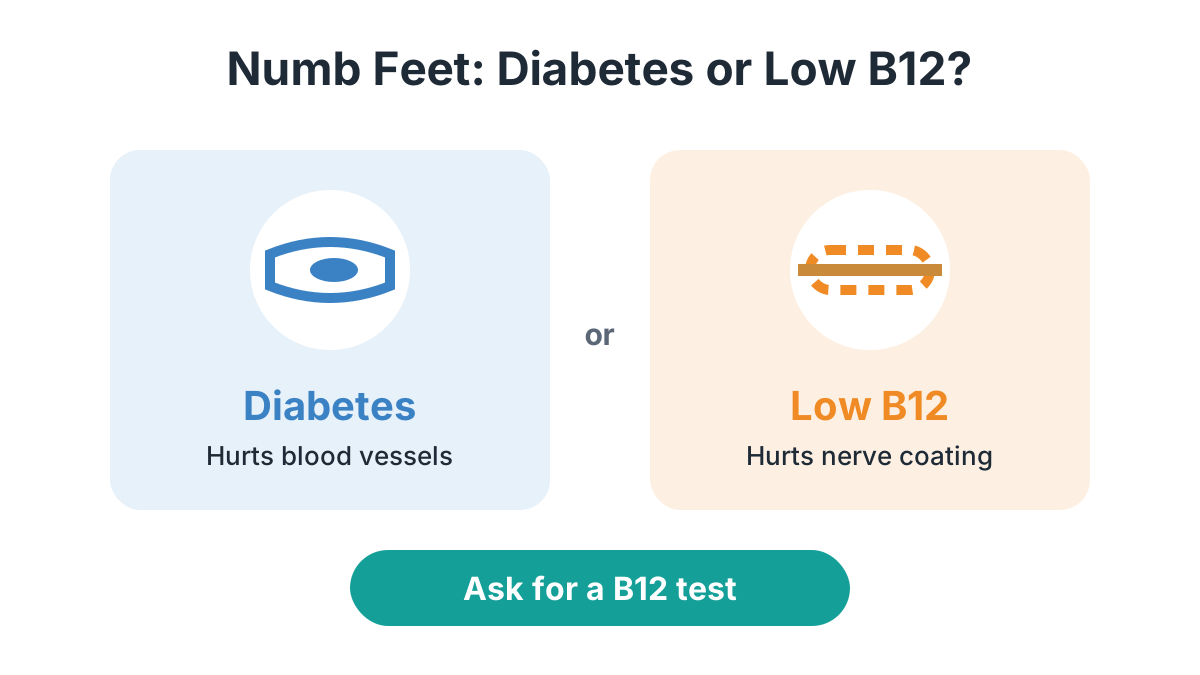
The two problems damage nerves in different ways. In diabetes, high sugar hurts the tiny blood vessels that feed your nerves. Without blood supply, the nerves slowly die.
B12 works differently. Think of a nerve like an electric wire. There is copper inside and a plastic coating outside. Your body needs B12 to make that coating, which doctors call the myelin sheath. When B12 runs low, the wire is still there, but the coating wears away. The nerve is exposed, and you feel the same numbness and burning.
In plain English: the symptoms look the same, but B12 nerve damage has a fix we can test for.
Metformin B12 Deficiency: How Metformin Lowers Your B12
First, let me be very clear. Metformin is a great medicine. It is safe, cheap, and has helped millions of people. This post is not about stopping it. It is about knowing one side effect so you can catch it early.
Here is how your body normally absorbs B12:
- Stomach: Stomach acid helps make a protein called intrinsic factor. B12 from your food sticks to it.
- Small intestine: The B12 travels all the way to the last part of the gut, called the ileum.
- Into the blood: There, calcium-dependent “pumps” pull the B12 into your bloodstream.
Metformin seems to interfere with that last calcium-dependent step (Diabetes Care). Your liver keeps a reserve of B12 that can last for years, so nothing happens at first. But after many years on metformin, that reserve can run low.
The numbers back this up. In the large Diabetes Prevention Program study, about 1 in 5 people on metformin had low or borderline B12 after 5 years, compared with about 1 in 10 on placebo. Each extra year on metformin raised the odds of deficiency by about 13 percent. People on metformin with low B12 also had more neuropathy (Journal of Clinical Endocrinology & Metabolism).
The UK drug safety agency now lists low B12 as a common side effect of metformin, affecting up to 1 in 10 people. Higher doses and longer use raise the risk (MHRA).
For a deeper look at how diabetes affects your body, read our guide on how diabetes affects your organs.
Clues That Point to B12, Not Just Diabetes
This is the part I want you to remember. B12 does more than protect your nerves. So when B12 is low, you often get other symptoms too.
1. Balance and vibration problems
The back part of your spinal cord carries two special senses. One tells you where your body is in space. The other feels vibration. B12 deficiency often damages this area. You may feel unsteady, bump into things, or fall. Many patients think they are just getting clumsy.
2. Brain fog
Your brain needs B12 to work well. Low levels can make it hard to think clearly or remember things.
3. A sore, red tongue
A swollen, smooth, or painful tongue is a classic sign. Doctors call it glossitis.
4. Tiredness
B12 helps you make healthy red blood cells. Without it, you may feel worn out all the time.
If you have numb feet plus any of these, tell your doctor. Your body is giving you a clue.
Acid Reflux Medicines Can Lower B12 Too
I am seeing a new pattern in my clinic. Many patients now take GLP-1 medicines like Ozempic, Mounjaro, Trulicity, or Zepbound. When the dose goes up too fast, some get heartburn and reflux.
What do they take for it? Often omeprazole, Nexium, Protonix, or Pepcid (famotidine). These medicines lower stomach acid. But remember, you need stomach acid to start absorbing B12. A 2023 review found people on acid-blocking pills called PPIs had about 42 percent higher odds of B12 deficiency (American Family Physician).
So now some patients have two things working against them: metformin and an acid reducer. If that sounds like you, ask your doctor about a B12 check. You can learn more about these medicines in our post on GLP-1 side effects.
Tests to Ask Your Doctor For
Many people assume a normal blood count means their B12 is fine. That is not always true. Low B12 can damage your nerves before it ever shows up as anemia. If we wait for the blood count to change, nerve damage may already be hard to reverse.
Here are the tests that help:
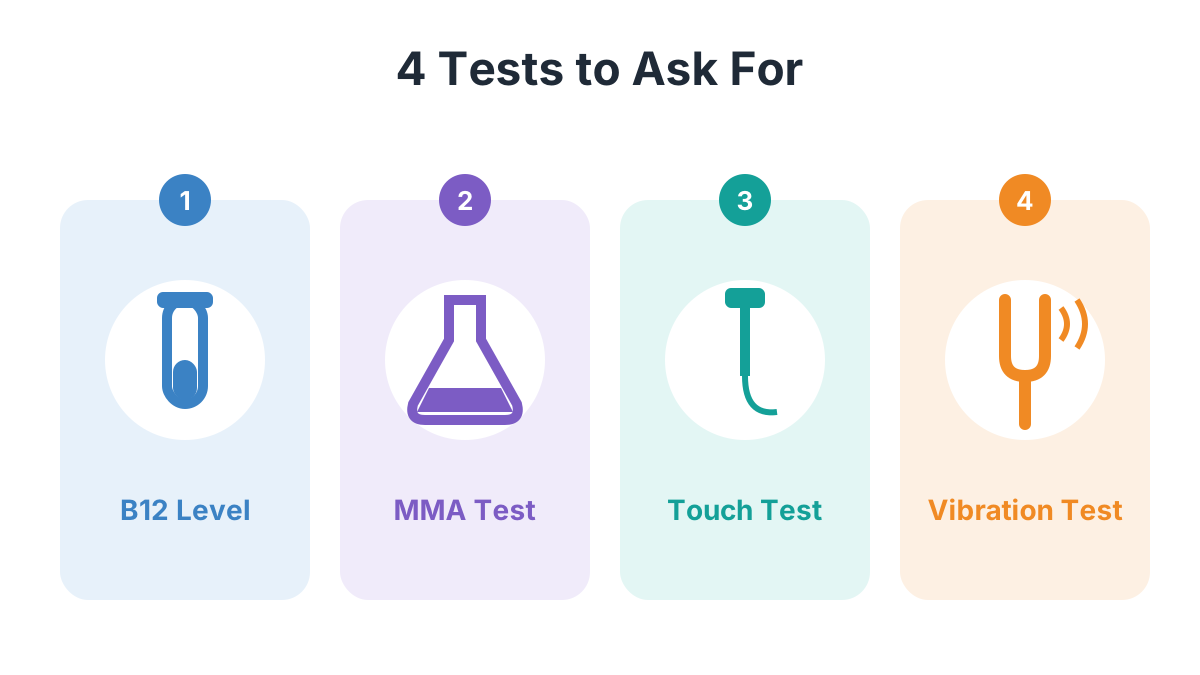
- Vitamin B12 blood level: Below 180 pg/mL usually means deficiency. Between 180 and 350 is a gray zone (American Family Physician). In my practice, I like to see patients with nerve symptoms above 400.
- MMA test (methylmalonic acid): If your B12 is in the gray zone and you have symptoms, this test helps. A high MMA points to B12 deficiency, even with a normal blood count.
- Monofilament test: Your doctor touches your feet with a thin nylon thread to check feeling.
- Tuning fork test: A vibrating tuning fork on your toe checks your vibration sense, one of the first things B12 deficiency affects.
Health agencies now advise doctors to consider checking B12 from time to time in people who take metformin long term (American Family Physician). If you have been on metformin for years and nobody has checked, it is fair to ask. For help reading your result, see our post on borderline vitamin B12 levels.
4 Common Myths About Metformin and B12
Myth 1: “I should stop metformin.”
No. Keep taking it. If your B12 is low, your doctor can treat it while you stay on metformin (MHRA).
Myth 2: “My blood count is normal, so my B12 is fine.”
Not true. B12 deficiency can hurt your nerves with no anemia at all.
Myth 3: “Only metformin matters.”
Acid reducers like omeprazole, Nexium, and famotidine can lower B12 too.
Myth 4: “Numb feet in a diabetic always means diabetic neuropathy.”
Often it does. But balance problems, brain fog, a sore tongue, or tiredness may mean B12 is part of the story.
How to Treat Low B12 (Without Wasting Money)
The good news is that B12 is easy and cheap to replace.
Most of the B12 in a pill is not absorbed in the normal way. But at high doses, a small amount, roughly 1 percent, still slips through directly. With a 1,000 microgram daily pill, that small amount is usually enough. Research shows 1,000 micrograms by mouth works about as well as B12 shots for most people (American Family Physician). For severe cases or serious nerve symptoms, your doctor may still choose shots.
My advice on supplements is simple:
- Get tested first, so you know what you are treating.
- A plain, low-cost B12 pill from the pharmacy is usually all you need.
- Skip expensive “nerve formulas” and special blends. You do not need them.
For more background, read our guide on vitamin B12 deficiency and how to treat it.
Your Checklist for the Next Doctor Visit
- Tell your doctor about all your symptoms, not just numb feet. Mention balance trouble, falls, brain fog, a sore tongue, or tiredness.
- Ask for a B12 blood test, especially if you have taken metformin for years.
- If your B12 is borderline, ask about an MMA test.
- Ask for a foot exam with the monofilament and tuning fork tests.
- List every medicine you take, including over-the-counter heartburn pills.
Your numb, burning feet may not be “just diabetes.” Metformin B12 deficiency is common, easy to test for, and cheap to treat. A simple blood test could change your treatment, and how you feel.
Frequently Asked Questions
Is metformin B12 deficiency common?
Yes, fairly common. Long-term metformin use lowers B12 in some people, especially at higher doses and after many years.
Should I stop metformin if my B12 is low?
No. Most people keep taking metformin and add a B12 supplement. Talk to your doctor before changing anything.
How can I tell B12 neuropathy from diabetic neuropathy?
They feel alike. Balance problems, brain fog, a sore tongue, and tiredness point more toward B12. A blood test gives the answer.
How much B12 should I take?
Many doctors use 1,000 micrograms a day by mouth. Ask your doctor for the right dose for you.