Picture this: a Florida patient dealing with a recurring respiratory issue walks into a chain urgent care center for the third time in four months. Same clipboard, same paperwork, different provider, same prescription. Two weeks later, same problem. It’s a hypothetical scenario, but it reflects a pattern that plays out regularly, patients cycling through episodic care with no one tracking the bigger picture.
This isn’t an indictment of urgent care centers. They serve a real and specific purpose. But a growing number of Florida patients are realizing that convenience and continuity are two very different things, and that conflating the two costs more than just copays. If you’ve been wondering why choose an independent primary care clinic over a chain urgent care in Florida, the answer comes down to what each model is actually built to do, and what each one can’t.
Why choose an independent primary care clinic over a chain urgent care in Florida
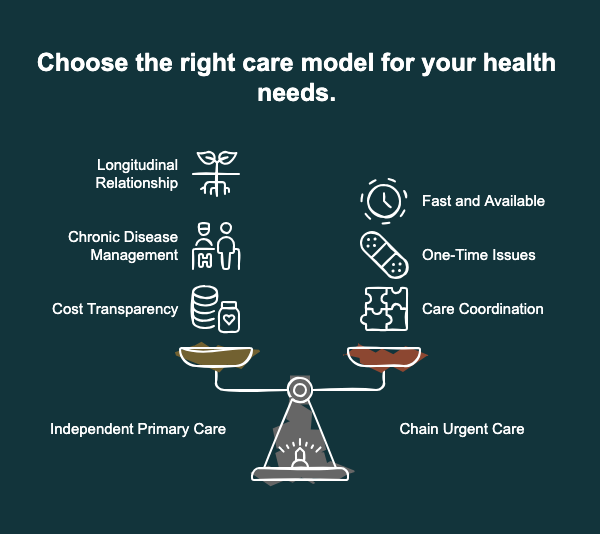
Independent primary care clinics are typically physician-owned or physician-led practices where the same providers see the same patients over time. Chain urgent care centers are corporately owned with staffing that varies across multiple locations, optimized for throughput rather than relationships. In Florida, physician-owned practices may qualify for exemptions under the state’s Health Care Clinic Act that chain urgent care centers do not, since chains are required to license every location separately. That regulatory distinction reflects a deeper operational reality: one model is built for relationships, the other for transactions.
What happens to your medical history at each type of facility matters more than most patients realize. At a chain urgent care center, your visit is essentially self-contained. The provider reads what you tell them, treats the immediate problem, and closes the chart. At an independent primary care clinic, your physician builds a longitudinal record over time, your patterns, your medications, your family history, your preferences. That context changes the quality of every single visit, not just the ones where something is clearly wrong.
Why continuity of care changes your long-term health outcomes
The research here is not subtle. According to a widely cited meta-analysis of 22 studies across nine countries, patients who maintained consistent care with the same physician had lower mortality rates in the majority of cases examined. High continuity of care is also associated with fewer hospitalizations, fewer emergency department visits, better medication adherence, and stronger management of chronic conditions like hypertension and type 2 diabetes. These outcomes aren’t coincidental. They’re the direct result of a provider who knows your baseline, catches changes early, and intervenes before a manageable issue becomes a crisis.
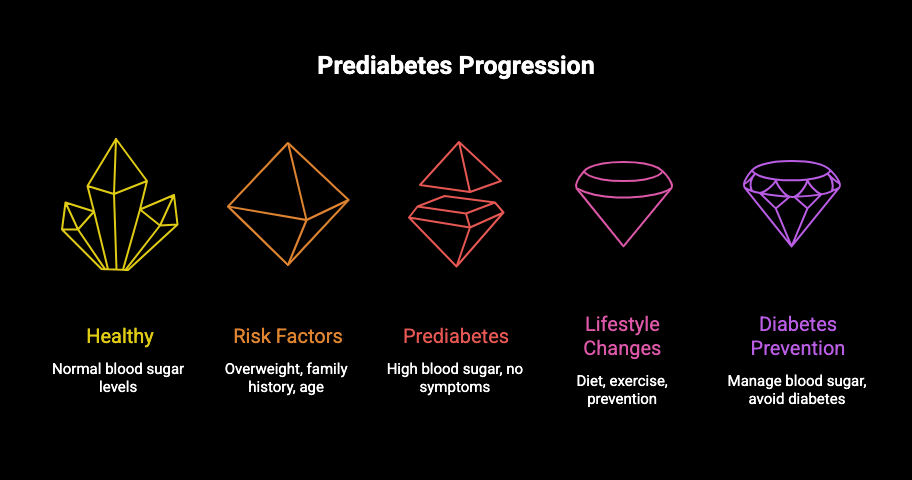
Visits to a chain urgent care center are often episodic, with limited longitudinal context unless records happen to be integrated from a prior visit. For a one-time sprained ankle, that works fine. For a patient with uncontrolled blood pressure or early-stage diabetes, fragmented episodic care is linked to higher healthcare costs and worse disease management over time. Chronic conditions require a provider who remembers last month’s numbers, not just today’s complaint. Diabetes and hypertension are among the most frequently undertreated conditions in patients who rely on urgent care as their default, precisely because those conditions need ongoing, coordinated monitoring that episodic visits can’t provide.
The real cost comparison Florida patients rarely see upfront
Cost comparison: independent primary care clinic vs. chain urgent care
Self-pay costs tell a clear story. For a common sick visit in Florida, independent primary care clinics typically charge less than chain urgent care centers, which can run 30 to 50% higher for equivalent conditions. For insured patients, primary care copays in Florida generally run lower than urgent care copays, which carry additional facility fees layered on top of provider fees. If you’re using urgent care as your default several times a year, that difference adds up to real money.
There are also costs that don’t show up in the copay comparison. Because chain urgent care centers often lack access to a patient’s existing records, duplicate lab work can become a factor, a pattern that research on episodic vs. longitudinal care has flagged as a driver of unnecessary healthcare spending. Out-of-network billing is a real risk too: some chain urgent care locations have broad national network contracts but may not be in-network with your specific Florida insurance plan. Independent clinics, especially smaller physician-owned practices, tend to offer more transparent and predictable pricing. They’re also more likely to flag what your insurance will and won’t cover before you leave the exam room.
What chain urgent care centers are structurally not built to do
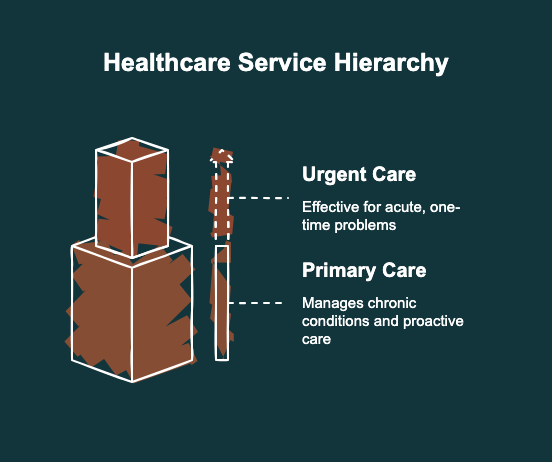
Chain urgent care centers are designed for volume and throughput. They’re effective at acute, one-time problems: infections, minor injuries, rapid strep tests. What they are not designed to do is manage your A1C over 12 months, coordinate your blood pressure medications across three refills, or catch that you’re overdue for a colorectal cancer screening. Independent primary care clinics run chronic care management programs specifically for patients with ongoing conditions, structured follow-up, medication reviews, and proactive outreach that urgent care simply doesn’t offer.
Care coordination is the other gap. When you need a specialist referral in cardiology, endocrinology, or orthopedics, an independent primary care physician does the coordination: sharing your records, identifying trusted specialists, and following up on results. At a chain urgent care center, you typically walk out with a suggestion to “see a specialist” and a printout.
Patient satisfaction data reflects this gap directly. Surveys comparing clinician-owned practices to system-owned and chain facilities consistently show higher satisfaction scores at independent clinics, a difference researchers attribute to patients feeling known, advocated for, and followed through on. Some independent primary care practices also operate under a patient-centered medical home (PCMH) model, a care framework specifically designed to coordinate all aspects of a patient’s health across providers, which chain urgent care centers are not structured to support.
The clinic model that gives you both: walk-in access and real primary care
The common assumption in Florida is that if you want to see a doctor today, you go to urgent care, and if you want continuity, you wait weeks for a primary care appointment. That tradeoff is real at many practices. Primary care appointment wait times in Florida can stretch two to three weeks, which is a key reason urgent care chains expanded so quickly across the state.
Reasons to choose an independent primary care clinic over a chain urgent care in Florida become especially clear when a practice combines the access patients want with the continuity they need. Shield Medical Group in Sebring and Lake Wales offers same-day and walk-in appointments within a full-service independent primary care practice, immediate access without sacrificing the longitudinal care that produces better health outcomes. Patients work with consistent providers who build records over time, manage chronic conditions, offer preventive screenings, and coordinate specialist referrals. Telehealth services extend that access further for patients in rural Highlands and Polk counties who can’t always come in person. It’s not urgent care, and it’s not a three-week wait.
Questions to ask before you choose or switch providers in Florida
Before making a chain urgent care center your default healthcare option, ask a few direct questions. Will you see the same provider each time? Can this clinic manage your ongoing prescriptions or chronic conditions? Do they have access to your records from your last visit? If the answer to any of those is no, you already know the limits of that model. It doesn’t make it useless, it makes it the right tool for the right situation, which is an acute, isolated problem when nothing else is available.
When evaluating an independent primary care clinic in Florida, the questions shift. Ask whether they offer same-day or walk-in appointments. Ask whether they have chronic disease management programs for patients with diabetes, hypertension, or heart disease. Confirm whether they accept Medicare or your specific insurance plan, and whether telehealth is available. Ask how they handle after-hours questions. A clinic that checks all those boxes and has locations in your county is worth establishing care with before a health issue forces you to decide in a hurry.
- Do you offer same-day or walk-in appointments?
- Do you have chronic disease management programs on-site?
- Do you accept Medicare, Medicaid, or my commercial insurance plan?
- Is telehealth available for follow-ups or after-hours questions?
- Will I see the same provider consistently over time?
Make this decision before you need it urgently
Choosing between an independent primary care clinic and a chain urgent care in Florida doesn’t have to be all-or-nothing, but it does require knowing what each model actually does well. Urgent care chains are fast and available, genuinely useful for true one-time issues. Independent primary care clinics deliver the longitudinal relationship, chronic disease management, cost transparency, and care coordination that produce better health outcomes over time. For patients thinking through why choose an independent primary care clinic over a chain urgent care in Florida, that sustained relationship is the core answer.
If you’re in central Florida and looking for a practice that combines walk-in convenience with full primary care continuity, Shield Medical Group has locations in Sebring and Lake Wales serving Highlands and Polk counties. You can call to establish care, ask about same-day availability, or explore telehealth options for your situation. Building that relationship now, rather than after the third visit for the same unresolved problem, is the kind of decision your future self will appreciate.