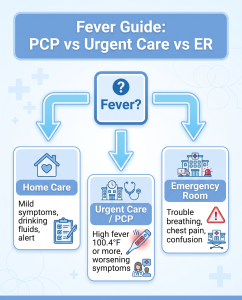
 This fever guide helps you decide fast: with a fever, should you use home care, see your PCP, go to urgent care, or head to the ER? It’s 9 PM. Someone in your house has a fever. You’re standing in the bathroom holding a thermometer, and three options are staring back at you: wait it out, drive to urgent care, or head to the ER. Nobody handed you a rulebook for this moment, so most people either over-react and spend four hours in an emergency waiting room, or under-react and wake up the next morning with a situation that got worse overnight. This fever guide breaks that decision down step by step so you can act quickly.
If you’re asking yourself whether you should go to urgent care or your primary care doctor for a fever, or whether the ER is actually necessary, the answer depends on more than just the number on the thermometer. Age, how long the fever has lasted, and what other symptoms are showing up alongside it all change the calculus significantly. A 102°F fever in a healthy 35-year-old is a different situation than a 102°F fever in a two-month-old or an elderly person with diabetes. Use this fever guide to weigh those factors quickly.
This fever guide maps out three clear tiers: home care, same-day clinic or urgent care, and the ER. Most fevers belong in the first two categories. Clinics like Shield Medical Group in Sebring are specifically built for the middle tier, where someone needs to be seen the same day but has no business sitting in an emergency room for hours. Knowing which tier you’re dealing with saves time, money, and a lot of unnecessary stress.
What Actually Counts as a Fever
The 100.4°F Threshold and Why It Matters
Clinically, a fever is defined as a temperature at or above 100.4°F (38.0°C). That’s the standard threshold used across CDC guidance, AAP pediatric recommendations, and virtually every major hospital system in the country. Anything between 99°F and 100.3°F is a low-grade elevation, not technically a fever, and generally does not require a visit anywhere unless other symptoms are present.
On the upper end, a very high fever changes the urgency level on its own. A temperature of 103°F or above in an adult, or 105°F or above in a child, is a separate category that warrants faster action even if no other alarming symptoms are present yet.
How You Measure Changes the Number
Rectal temperatures run slightly higher than oral readings; oral temperatures run slightly higher than axillary (armpit) readings. This distinction matters most with infants, where the precision of that number directly determines the level of care needed. A rectal reading is the most accurate method for babies and young children.
For adults, oral or rectal readings are more reliable than forehead strips or ear thermometers. Whatever method you use, be consistent, and note which one you used when you call a clinic or describe symptoms to a provider.
When Home Care Is Enough
The Three Basics Before You Pick Up the Phone
Rest, fluids, and acetaminophen or ibuprofen as directed are the foundation of at-home fever management. These reduce discomfort and support recovery without interfering with the immune response that’s actively fighting whatever triggered the fever. The goal of fever medicine is comfort, not a perfect 98.6°F on the thermometer. For more on adult fever treatment and when to medicate, see Harvard Health’s advice on treating fever in adults.
Avoid alcohol and caffeine while running a fever; both can accelerate dehydration and make recovery harder. Light clothing, a cool room, and a lukewarm compress are more effective for comfort than heavy blankets or cold compresses. Do not use ice baths or alcohol rubs, especially with children.
The Watch-and-Wait Window
For adults and children older than 2 years with no red-flag symptoms, a fever under 103°F that has lasted fewer than 48 hours is generally manageable at home. If the fever is responding to medication, the person is drinking fluids, staying alert, and breathing normally, home care is still appropriate at this stage.
The CDC’s standard benchmark for returning to school or work is 24 hours fever-free without fever-reducing medication. That bar exists for a reason: a temperature that keeps climbing back up the moment ibuprofen wears off is telling you something isn’t resolved yet.
Signs That Home Care Is No Longer Enough
Call a doctor or head to a clinic if the fever climbs above 103°F in an adult, or if it persists beyond 48 to 72 hours despite home care. Any new symptom joining the fever, a rash, ear pain, difficulty swallowing, or burning with urination, is a signal to get evaluated rather than wait another day. For common diagnostic steps and warning signs, see the Mayo Clinic’s guidance on fever diagnosis and treatment.
Dehydration is another exit ramp from home care. Dry mouth, no urination in eight or more hours, and dizziness all indicate the body is losing more fluid than it’s taking in. That situation needs clinical attention, not just more water.
Should You Go to Urgent Care or Your Primary Care Doctor for a Fever?
The Moderate-Symptom Category
Fever lasting more than 48 hours without a clear cause, or fever paired with a worsening cough, sore throat, ear pain, or mild body aches, belongs in this middle tier. These situations need a clinical eye, possibly a strep test, flu swab, or urinalysis, but they do not need an emergency room. Sending a patient with a 48-hour sinus fever to the ER clogs the system and costs significantly more than a same-day clinic visit.
Adults with chronic conditions like diabetes, heart disease, or kidney disease should lean toward being evaluated sooner rather than later in this range. Those underlying conditions change how the body handles infection, and a fever that looks routine in a healthy adult can progress faster in someone with a compromised baseline.
The Same-Day Access Problem Most Patients Face
The traditional PCP appointment is often unavailable within 24 to 48 hours of a sick call, which pushes patients toward urgent care chains for care that should be coming from their own doctor. This is where the gap gets expensive and frustrating. Urgent care visits cost more than a standard office visit and leave no follow-up thread connected to your medical history.
If you’re in the Sebring or Lake Wales area and your fever falls into the same-day clinic category, Shield Medical Group offers walk-in appointments that put you in front of a primary care physician the same day, with your medical history on hand and a provider who can follow up if the situation changes. That context matters when a provider is deciding whether your fever is the start of something serious or a straightforward viral illness.
Telehealth as a First-Step Option
For a fever paired with classic cold, flu, or COVID symptoms in a stable adult, a telehealth visit can assess the situation quickly and determine whether a prescription or in-person visit is needed. This works well when the patient is older than 3 months, breathing normally, staying hydrated, and showing none of the red flags covered later in this article.
Telehealth does not replace a physical exam when one is clearly needed. But for a straightforward presentation at 8 PM on a Tuesday, it can get treatment started faster than waiting until morning, and is considerably cheaper than an urgent care or ER visit. Shield Medical Group offers telehealth options for exactly these situations.
Age and Health Conditions That Change Every Rule
Infants Under 3 Months: No Waiting
Any fever at or above 100.4°F in an infant under 3 months is a medical urgency, full stop. This age group requires immediate evaluation, typically at an ER or same-day urgent facility, not a scheduled appointment for next week. Do not give fever-reducing medication to an infant this young without direct medical guidance first; antipyretics can mask a serious bacterial infection and delay necessary treatment. Guidance such as the UCSF febrile infant guidelines outline the evaluation steps clinicians follow.
If the baby looks pale, is not feeding, or is unusually quiet alongside the fever, call 911 or go directly to the ER without waiting to see whether the temperature climbs further. In the youngest infants, a fever can be the only outward sign of a systemic infection that moves fast.
Children Under 2 Years
Guidelines remain more conservative than for older children through the first two years of life. Fever without another clear cause lasting more than 24 hours in a child under 2 warrants a same-day call to a physician, not a wait-and-see approach. Watch hydration closely in this age group; an inability to keep fluids down moves the situation into urgent care or ER territory quickly.
For infants between 3 months and 2 years, the severity of symptoms and the child’s overall appearance matter as much as the temperature reading. A lethargic, pale, or unusually quiet child should be evaluated regardless of the exact number on the thermometer.
Elderly Patients and Immunocompromised Adults
Older adults often run lower baseline temperatures, which means a reading of 100.4°F may represent a more significant immune response than it does in a 30-year-old. Confusion, weakness, or any change in mental status alongside a fever in an elderly patient should be treated as an emergency, not a situation to monitor overnight without guidance. These presentations can be the first sign of sepsis or a serious infection that requires immediate intervention.
Immunocompromised patients, including those on steroids, chemotherapy, or with conditions like HIV or uncontrolled diabetes, should contact a clinician at the first sign of fever rather than waiting for it to climb. In these patients, even a modest fever can signal a rapidly progressing infection that requires same-day evaluation and possible escalation to the ER. There is no safe “wait 48 hours” window for this group.
Red Flags That Mean Skip Urgent Care and Go Straight to the ER
Adult Emergency Symptoms
Go directly to the ER if a fever is paired with any of the following: confusion or altered speech, difficulty breathing, chest pain, a stiff neck, a severe headache, seizure, persistent vomiting, or a spreading rash. Any one of these symptoms alongside a fever is enough. You do not need to check off a full list to justify going.
A fever of 103°F or higher in an adult with no other symptoms warrants at minimum an urgent call to a physician and consideration of a same-day in-person evaluation. The temperature itself is not an ER-level emergency in an otherwise healthy adult, but it’s not something to leave unmonitored through the night either.
Pediatric Emergency Warning Signs
Take a child to the ER immediately for any of the following: rapid or labored breathing, a stiff neck, a seizure, extreme sleepiness or difficulty waking, inconsolable crying, inability to keep any fluids down, no urination for eight or more hours, a new rash, or a dull and unresponsive appearance. A temperature of 105°F or higher in any child is a medical emergency regardless of other symptoms.
Trust your instinct as a parent. If something about the child’s behavior or responsiveness looks wrong, that observation carries real clinical weight. A child who looks seriously ill but has only a 101.5°F fever still needs evaluation. The thermometer is one data point, not the whole picture.
How to Make the Call Quickly
Urgent Care, Your PCP, or the ER, Run Through These Questions First
Run through three quick questions before you decide. First: is this person in a high-risk group, infant under 3 months, elderly, or immunocompromised? If yes, call a physician or go in now. Second: are any red-flag symptoms present, such as a stiff neck, confusion, breathing difficulty, seizure, or spreading rash? If yes, go to the ER. Third: has the fever lasted more than 48 hours, climbed above 103°F, or paired with symptoms that are getting worse rather than better? If yes, this is a same-day clinic situation, not home care.
If none of those questions triggers a “yes,” you’re almost certainly in the home-care category: monitor, hydrate, medicate for comfort, and reassess in the morning.
Matching the Situation to the Right Option
- Home care fits a stable person with a fever under 103°F, fewer than 48 hours of symptoms, no red flags, and the ability to keep fluids down.
- Same-day primary care or urgent care fits moderate symptoms, fever persisting beyond 48 hours, or a situation where a test or prescription is needed but no emergency signs are present.
- The ER fits any red-flag symptom, any infant under 3 months with a fever, or a high-risk adult with a fever and a deteriorating condition.
Using Same-Day Primary Care Instead of Defaulting to the ER
If you’re in the Sebring or Lake Wales area and your fever falls into the same-day clinic category, Shield Medical Group offers walk-in appointments that put you in front of a primary care physician the same day, with your medical history on hand and a provider who can follow up if the situation changes. That’s a more appropriate and thorough option than the ER for non-emergencies, and more continuity than a standard urgent care chain for anything involving ongoing health conditions.
Call ahead or walk in; either way, you won’t spend your evening in an ER waiting room for a fever that doesn’t belong there. The right door matters as much as getting through one.
The Takeaway: Your Quick Fever Guide
Whether you should go to urgent care or your primary care doctor for a fever comes down to four factors working together: temperature, duration, age, and accompanying symptoms. No single factor makes the decision on its own. A high temperature with no red flags in a healthy adult is a different situation than a moderate temperature with a stiff neck in a 70-year-old.
Most fevers in otherwise healthy adults and older children belong in the home-care or same-day clinic bucket, not the ER. The emergency room exists for emergencies, and using it for a 48-hour viral fever means longer waits, higher costs, and no real continuity with your medical history afterward.
If you’re unsure whether your fever needs attention today, a same-day visit to Shield Medical Group in Sebring is the faster, smarter first call, one that gets you in front of a physician who already knows your history and can follow your care through to resolution, without the wait or cost of an emergency room. Keep this fever guide handy so you can act with confidence the next time a fever strikes.
Bookmark this fever guide, share it with family members who care for young children or older adults, and revisit the fever guide whenever a temperature climbs and you are weighing home care against a clinic or ER visit. A clear fever guide turns a stressful moment into a simple, confident decision.
Fever Guide FAQs: Quick Answers
How do I use this fever guide at home? Use this fever guide to match the temperature and symptoms to the right tier of care. If the fever is mild and there are no red flags, the fever guide points to home care; if symptoms escalate, the fever guide moves you toward same-day clinic care or the ER.
When should I stop trusting the fever guide and call a doctor? The fever guide is a starting point, not a replacement for medical judgment. If anything feels wrong, follow the red-flag section of the fever guide and contact Shield Medical Group or head to urgent care right away.
Keep this fever guide handy on your phone so it is ready the next time a temperature spikes at an inconvenient hour. A good fever guide takes the panic out of the moment, and this fever guide is built specifically to help Sebring families decide between home care, a same-day visit, and the ER with confidence.