By Kulmeet Kundlas MD, Board-Certified Internal Medicine — Shield Medical Group, Sebring and Lake Wales, Florida
One question I hear almost every week in my clinic is this: can ivermectin cure cancer? A man with stage 4 colon cancer asks me. A woman with breast cancer asks me after her second round of chemo. When you are scared, you look for any hope you can find. I understand that. Nobody is judging you for asking. In this post, I will tell you what the science really says in 2026, in plain words.
Watch Dr. Kundlas explain what the latest research says about ivermectin and cancer in this video guide.
Disclaimer: This content is for educational purposes only and is not a substitute for personalized medical advice. Always consult your own healthcare provider for diagnosis and treatment. Never stop or change a cancer treatment without talking to your oncologist.
Where Did the Ivermectin Cancer Story Start?
It started with a podcast. In January 2025, actor Mel Gibson went on The Joe Rogan Experience. He said three friends with stage 4 cancer got better after taking ivermectin and another worm medicine called fenbendazole. The video got more than 13 million views on YouTube (NBC Washington).
A story on a podcast is not proof. We do not know what cancer those friends had or what other treatment they got.
Still, the podcast changed what people did. A May 2026 study in JAMA Network Open looked at the records of more than 68 million patients. In the six months after the episode, prescriptions for these worm medicines went up by 97 percent. For people with cancer, they went up more than 2.5 times (AJMC). The biggest jump was in the South, where I practice (Epocrates).
That study only counted prescriptions. It did not show that ivermectin helped anyone’s cancer.
What Is Ivermectin Approved For?
Ivermectin is a good medicine for the right job. In the United States, the pill is sold as Stromectol. It is approved for:
- Threadworm infection in the gut
- River blindness, a parasite that affects the eyes and skin
- Head lice (as a lotion)
- Rosacea (as a skin cream)
Cancer is not on this list. COVID-19 is not on this list either. For more background, read our earlier post on ivermectin for cancer.
Why Ivermectin Works in a Lab Dish but Not in Your Body
This is where most of the confusion comes from.
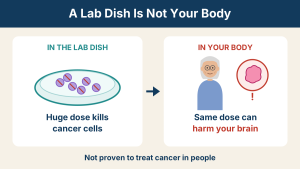
In a lab, scientists grow cancer cells in a small dish. Then they add ivermectin. In some tests, the cancer cells die. That sounds great. But the dose they use is much higher than what is safe for a person (Oncology Nursing News).
A lab dish has no brain, no heart, and no liver. You do.
Here is how ivermectin kills a worm. It opens tiny gates on the worm’s nerve cells. The worm cannot move, and it dies. Your body has similar gates, but mostly inside the brain. Your brain has a shield called the blood-brain barrier that keeps ivermectin out at normal doses.
At very high doses, that shield cannot keep up. The drug gets into the brain.
In plain English: the dose that might hurt cancer cells in a dish can also hurt your brain.
What Do the Ivermectin Cancer Trials Show in 2026?
The good news is that real researchers are now testing ivermectin. That is the right way to get answers. Here is where things stand.
- National Cancer Institute: Started a lab study in early 2026. It uses cells and animals, not people. No results that help patients yet (STAT News).
- Cedars-Sinai (breast cancer): Tested ivermectin with an immune drug in women with advanced triple-negative breast cancer. In early results, only 1 of 8 patients responded. Six got worse (ClinicalTrials.gov).
- University of Florida ICONIC trial: Signed up in March 2026 to test ivermectin in about 80 cancer patients. It has not started enrolling yet. Results are not expected before 2027 (ClinicalTrials.gov).
- Telehealth study (June 2026): This one went viral online. Patients reported their own results, and there was no comparison group. The journal quickly put an official Expression of Concern on it (Anticancer Research).
Bottom line: there is no positive human trial showing ivermectin treats any cancer. The American Cancer Society and the American Society of Clinical Oncology both advise against using it outside a clinical trial (PharmaVoice). To learn about Florida’s research money for this, see our post on Stromectol and Florida’s cancer research.
The Danger of Taking High Doses
The normal dose is not what worries me. What worries me is when people take 10 to 20 times the normal dose because they read online that more is better.
Watch for these warning signs:
- Nausea or vomiting
- Dizziness or fainting
- Confusion
- Trouble walking
- Blurry vision
- Seizures
- In the worst cases, coma or death
Older adults face extra risk. Many already take blood thinners or heart pills, and each new drug can change how the others work.
Some states now sell ivermectin without a prescription, including Arkansas, Idaho, Tennessee, Louisiana, and Texas (States Newsroom). Easy to buy does not mean it works for cancer. Those products are made for worm doses, not cancer.
Always Tell Your Cancer Team
Many patients take ivermectin and never tell their cancer doctor. Some do not trust doctors. Some are afraid of being scolded. Some just want every possible chance.
I understand. But here is the problem. If your team does not know, they cannot watch for side effects. A problem caused by ivermectin could be blamed on your chemo. Then a treatment that was working might get stopped for the wrong reason.
Good questions to ask your oncologist:
- Is there a clinical trial I can join?
- Can ivermectin mix badly with my cancer medicines?
- What other options have we not talked about yet?
If you are worried about breast cancer, our guide on breast cancer screening explains the current advice.
Took a high dose and feel sick? Call Poison Control at 1-800-222-1222. It is free and open 24 hours. For seizures or trouble breathing, call 911.
Does Ivermectin Work for COVID-19?
No. Large studies in people did not show it helps. The FDA says the trial data do not show ivermectin works against COVID-19 (FDA). It is the same story as cancer: good results in the lab, poor results in people.
My Honest Advice
I see your pain, and I know you need hope. Hope is good. But it should not put you in danger.
Right now, ivermectin is a great worm medicine and an unproven cancer treatment. I am watching the Cedars-Sinai and ICONIC trials closely. If good news comes, I will share it with you here.
Until then, keep it simple: talk to your cancer team, ask about clinical trials, and never take a mega-dose of any medicine because of a podcast.
Frequently Asked Questions
Can ivermectin cure cancer?
No. As of 2026, no study in people has shown that ivermectin cures or treats any cancer.
Can I take ivermectin with chemotherapy?
Not without asking your oncologist first. It can mix badly with some cancer drugs.
What happens if I take too much ivermectin?
You may get sick to your stomach, dizzy, or confused. Very high doses can cause seizures or coma. Call Poison Control at 1-800-222-1222.
Are there trials testing ivermectin for cancer?
Yes, at Cedars-Sinai and the University of Florida. Ask your oncologist if you qualify.